
 English
 简体中文
 繁体中文


Springless Barrier Gate vs. Traditional Spring Barrier Gate: Key Differences
Springless Barrier Gate vs. Traditional Spring Barrier Gate: Key Differences
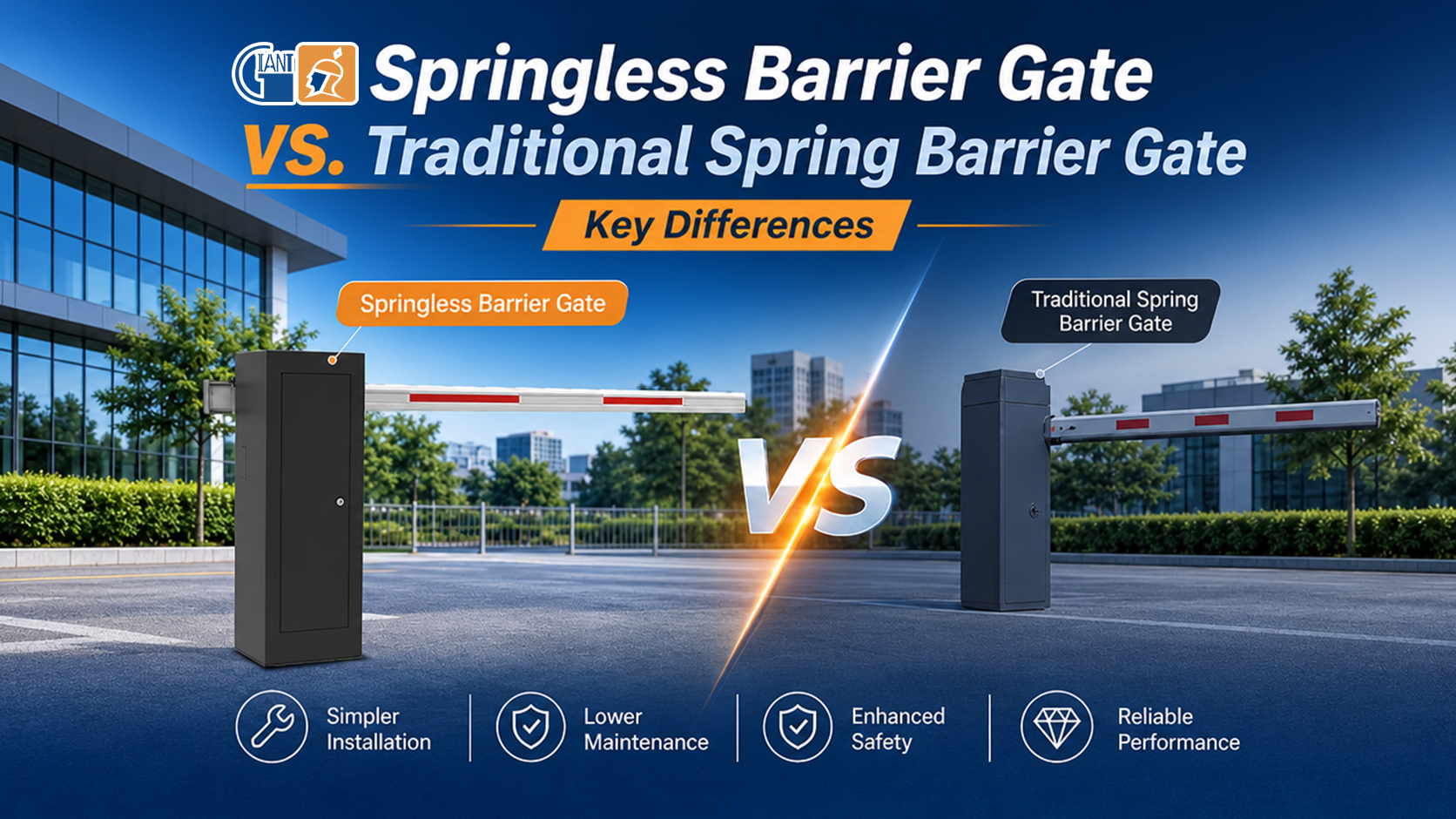
In high-traffic parking facilities, logistics centers, and commercial entrances, equipment reliability directly affects daily operations. Traditional spring barrier gates rely on mechanical springs to balance boom arm weight. However, repeated operation can lead to spring fatigue, reduced tension, and eventual failure.
A springless barrier gate uses motor torque control instead of a balancing spring, offering a different approach to equipment design, installation, and maintenance.
1. Key Differences Between Springless and Spring Barrier Gates
Operating Principle
Traditional automatic barrier gates use extension or torsion springs to balance the boom arm. Over time, spring fatigue may affect operating performance and increase maintenance requirements.
A springless barrier gate eliminates the balancing spring and uses a motor, gearbox, and electronic control system to manage boom arm movement. This removes spring-related wear and the need for regular tension adjustments.
Installation and Maintenance
Spring-based systems often require manual adjustments when changing boom arm lengths or installation directions. Incorrect tension may cause unstable movement or insufficient lifting force.
By comparison, a springless boom barrier simplifies installation through electronic parameter adjustments and flexible directional configuration. It also eliminates routine spring replacement, helping reduce maintenance work and improve maintenance planning.
However, the motor, gearbox, and control board still require regular inspection.
Power Failure and Safety
Without stored spring energy, springless systems avoid spring-driven rebound during manual operation. Actual power-off behavior depends on the braking mechanism and manual release design, which should be considered when selecting a barrier gate system.
2. JUJIANG GIANT WHDZ-220V: Springless Barrier Gate Solution
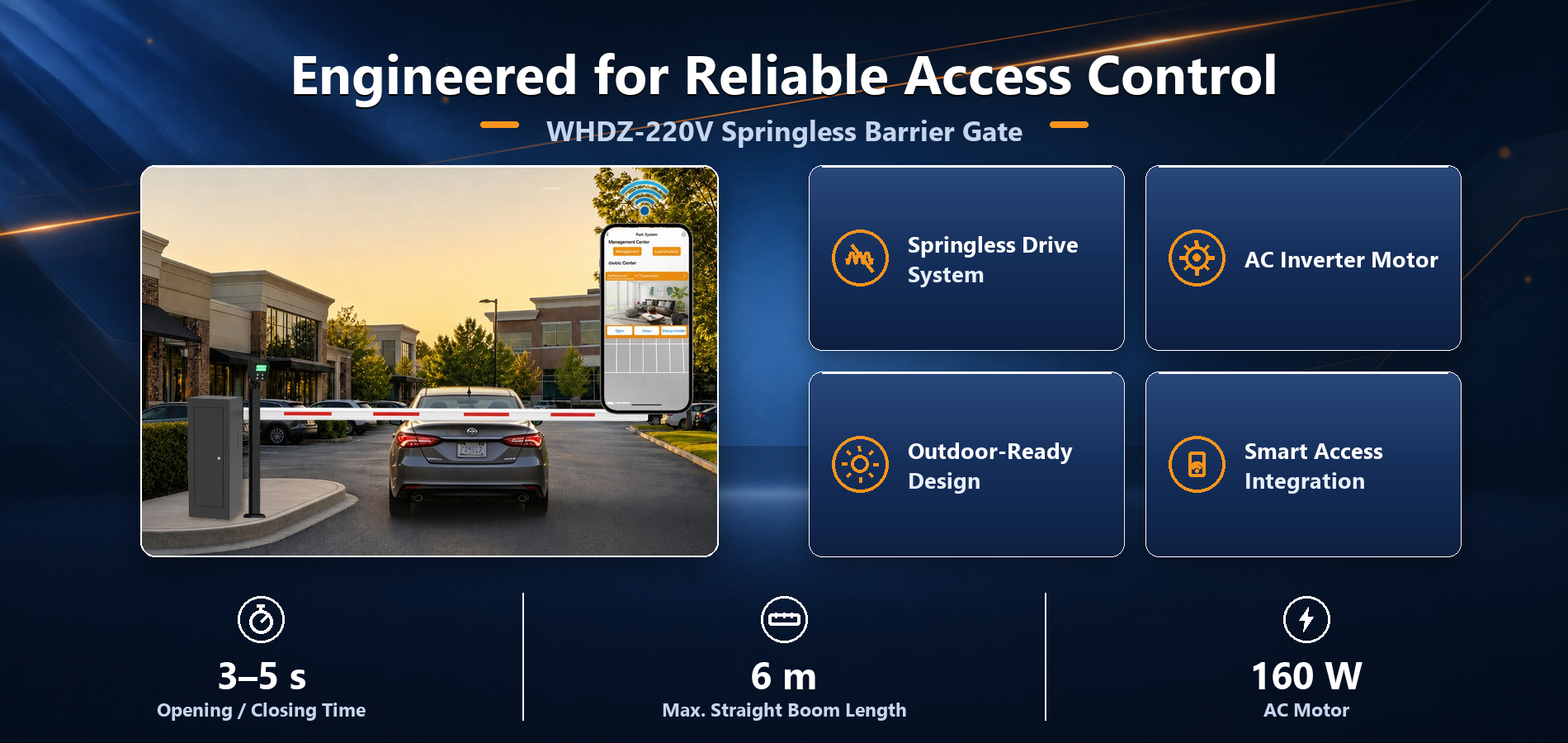
The JUJIANG GIANT WHDZ-220V automatic barrier gate combines a springless mechanism with an AC inverter motor for controlled and consistent operation.
Its key features include:
Springless Design & Inverter Motor: A 160W AC motor with variable-frequency control supports gradual acceleration and deceleration, reducing mechanical impact. Opening and closing times are approximately 3–5 seconds.
Easy Maintenance & Direction Adjustment: The side-opening cabinet provides convenient access to internal components. Left- and right-hand configurations can be changed by adjusting the limit blocks and motor wiring.
Outdoor Protection: IP55 protection and an operating temperature range of -20°C to +60°C support outdoor applications. It accommodates straight boom arms up to 6 meters and fence-style arms.
Safety & Smart Integration: Supports infrared photocells and vehicle loop detectors, with automatic stopping or reversing when configured. Overcurrent and motor overheating protection provide additional safeguards. Bluetooth connectivity enables X-HOUSE app control, parameter configuration, and remote management of transmitters and access cards. Integration with License Plate Recognition (LPR) systems is also supported.
A manual release mechanism allows operation during power outages or emergencies.
Conclusion
The main difference between a Springless Boom Barrier System and a traditional spring-based system lies in their balancing mechanisms. While conventional designs depend on spring tension, springless systems use controlled motor torque.
For high-traffic parking facilities and commercial access points, the JUJIANG GIANT WHDZ-220V combines springless construction, inverter motor technology, and smart integration to provide a practical automatic barrier gate solution.
 37 Sunshine Road, Photoelectric Information Industrial Park, Nan'an, Fujian, China
© Copyright: 2022 Giant Alarm System Co.,Ltd All Rights Reserved.

IPv6 network supported


