
 English
 简体中文
 繁体中文


How Does the IP Rating Affect an Electric Window Opener?
How Does the IP Rating Affect an Electric Window Opener?
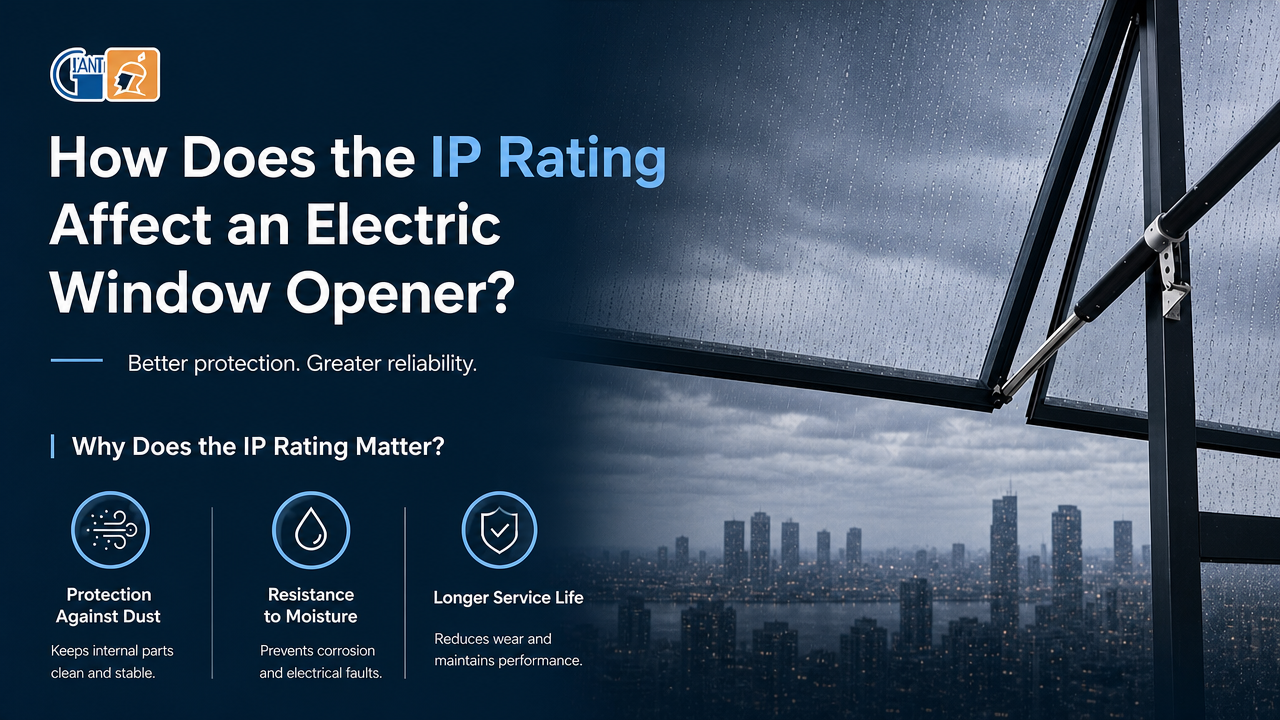
When selecting an electric window opener, factors such as thrust, stroke length, and control range are important, but the IP rating also plays a key role in long-term reliability. It indicates how effectively an enclosure protects internal components against dust and water. For window openers installed in curtain walls, skylights, conservatories, and other exposed environments, choosing an appropriate window opener IP rating helps protect electrical and mechanical components from moisture and dust, reducing the risk of corrosion, operating faults, and premature wear.
1. Why Does the IP Rating Matter?
Protection Against Dust and Moisture
Dust and moisture can enter an inadequately protected electric window opener, potentially affecting circuit boards, electrical connections, and sensors. Over time, this may lead to corrosion, control malfunctions, or unexpected shutdowns. A suitable window opener IP rating helps limit the ingress of environmental contaminants and maintain reliable operation.
Impact on Mechanical Performance and Service Life
Moisture can accelerate corrosion, while dust and debris may increase wear on moving components such as gears, screws, and bearings. Appropriate ingress protection helps reduce these risks, supporting smoother operation and a longer service life. This is especially valuable for skylights and high-level facade windows, where maintenance can be difficult and costly.
Reliability in Different Environments
Different installation environments expose electric window openers to varying levels of dust and moisture. Factors such as indoor or outdoor installation, exposure to rain, and surrounding conditions should be considered when selecting an appropriate window opener IP rating. Matching the protection level to the actual operating environment helps reduce the risk of ingress-related faults and supports reliable operation over time.
2. How to Choose the Right Window Opener IP Rating
To select the right window opener IP rating, start by assessing three factors: installation location, exposure to dust and water, and project specifications. For indoor windows in dry, sheltered areas, assess whether basic dust and splash protection is sufficient. For skylights, curtain walls, and conservatories exposed to rain or wind-driven moisture, consider a higher level of protection, such as IP65.
3. JUJIANG GIANT IP65 Electric Window Opener Solutions
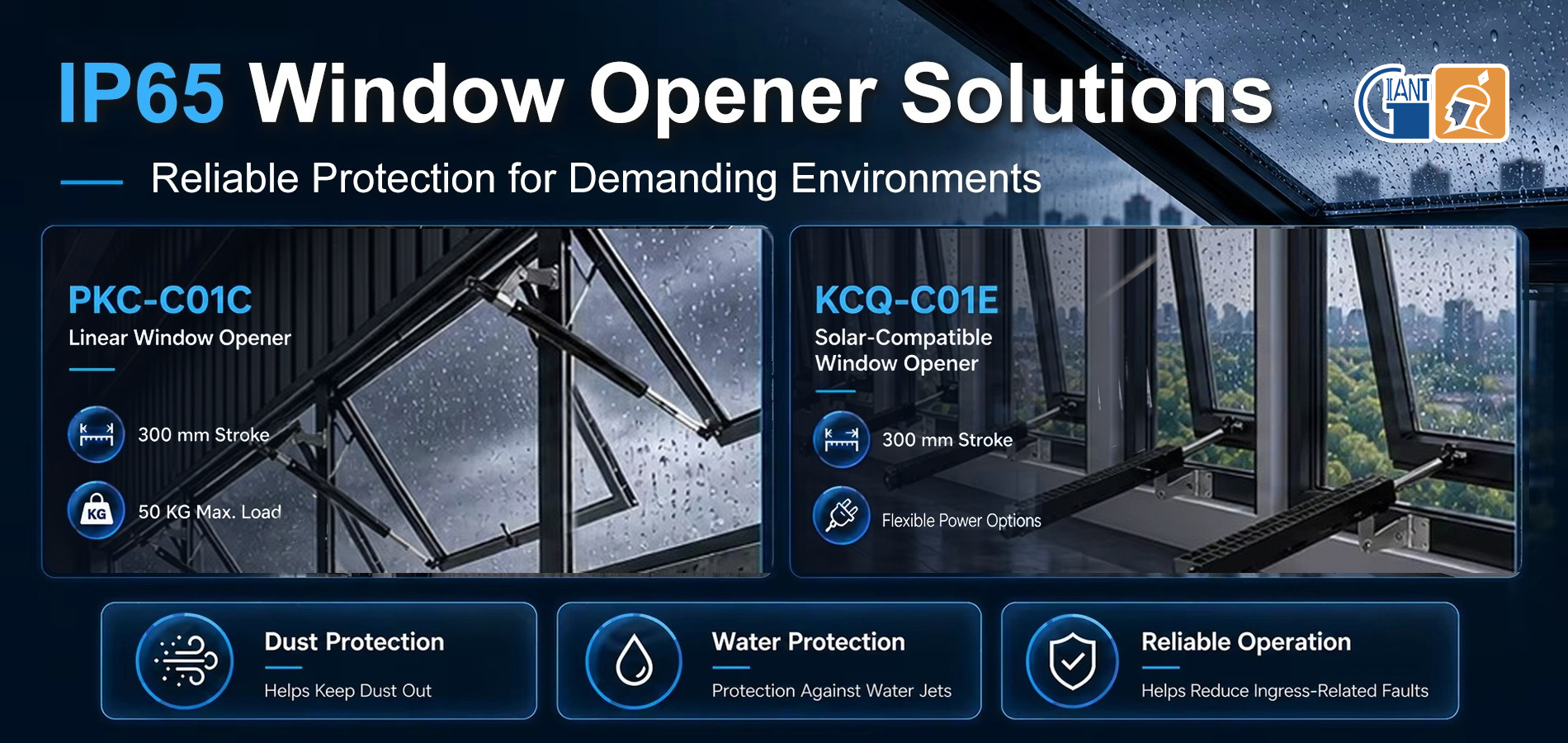
JUJIANG GIANT offers two IP65-rated electric window opener solutions for different project requirements.
PKC-C01C: Linear Window Opener
The PKC-C01C is a linear window opener designed for top-hung windows. It features a 300 mm stroke, supports windows up to 1.5 m wide and a maximum load of 50 kg, and operates from −45°C to +50°C. Features include soft start and stop, adjustable operating speeds, overcurrent detection, and obstruction-stop protection. A compatible rain sensor can trigger automatic closing when rain is detected, depending on the control configuration.
KCQ-C01E: Solar-Compatible Window Opener
The KCQ-C01E is a solar-compatible electric window opener featuring IP65 protection, a 300 mm stroke, and a maximum load of 50 kg. It supports AC 100–230 V input and a 12 V DC motor, with three built-in 3.7 V lithium batteries. It can be charged using a 12 V adapter or a compatible 12 V solar panel, helping reduce wiring requirements in suitable skylight, conservatory, and facade projects where conventional power connections are inconvenient.
Both models offer practical options for projects requiring IP65 protection, with different configurations to suit installation and power supply needs.
 37 Sunshine Road, Photoelectric Information Industrial Park, Nan'an, Fujian, China
© Copyright: 2022 Giant Alarm System Co.,Ltd All Rights Reserved.

IPv6 network supported


