
 English
 简体中文
简体中文  繁体中文
繁体中文 


Radar Sensors: Working Principle, Applications and Selection
Radar Sensors: Working Principle, Applications and Selection
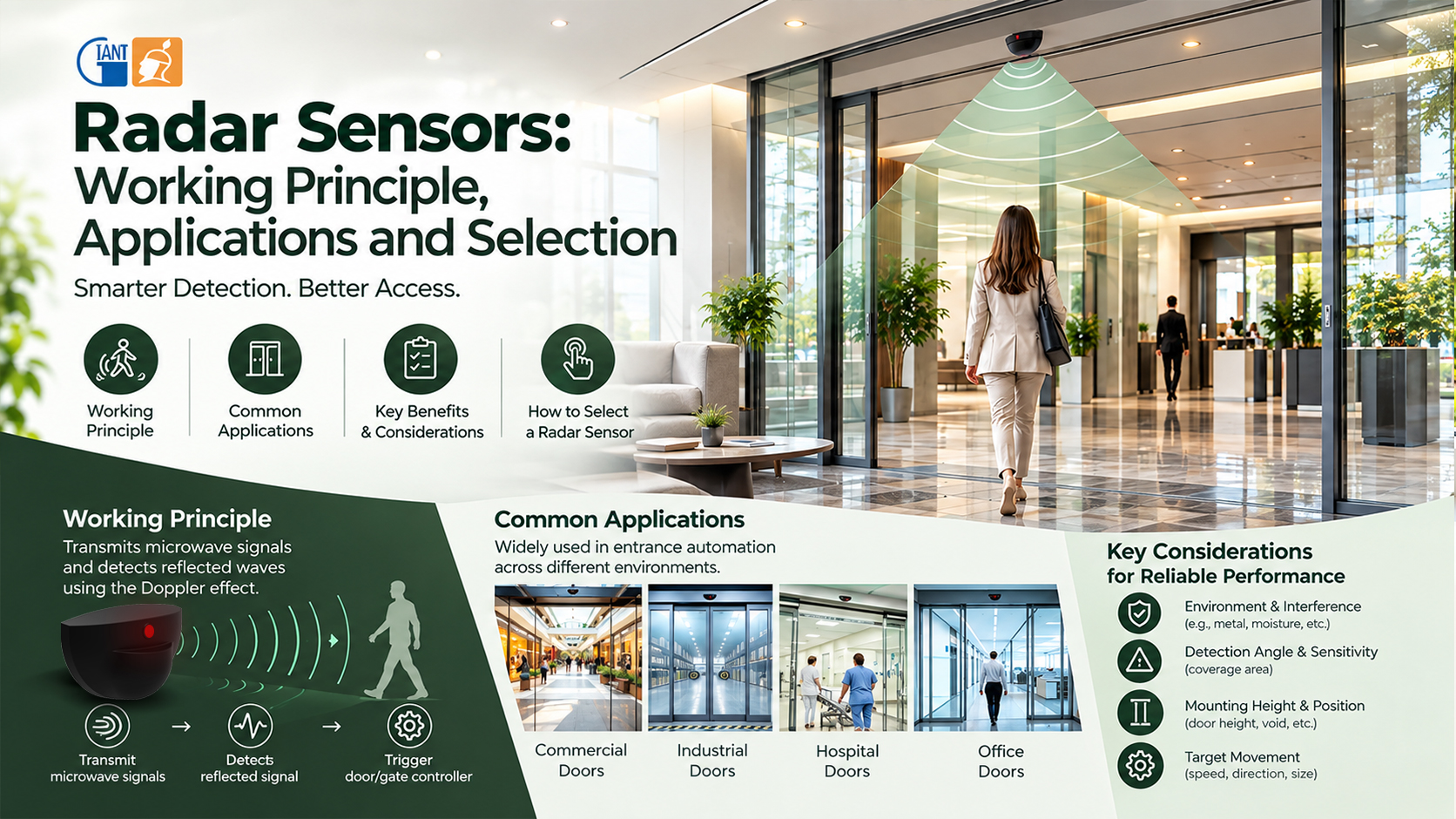
Radar sensors are used in entrance automation to detect people and moving objects without contact. Unlike infrared sensors, radar works by transmitting electromagnetic waves and analyzing reflected signals. This makes microwave radar a practical choice for automatic doors, industrial doors, gate systems and barrier gate applications where reliable motion detection is required.
How Does a Radar Sensor Work?
A radar sensor consists of a transmitting antenna, receiving antenna, signal-processing circuit and output interface. The sensor continuously emits microwave signals. When a moving person or object enters the detection area, the reflected signal changes in frequency due to the Doppler effect. The sensor then sends a trigger signal to the door or gate controller.
This operating principle makes a Doppler radar sensor suitable for automatic door activation. Commercial entrance systems commonly use 24 GHz microwave technology for motion detection, while advanced solutions can combine motion and presence detection. In professional installations, opening detection and safety detection may be handled by different sensing technologies rather than relying on one sensor for every safety function.
Common Applications
Radar sensors are widely used for indoor automatic door applications, providing fast and contactless motion detection for approaching pedestrians.
For automatic sliding doors, automatic swing doors and automatic revolving doors, radar detects movement within the sensing area and sends a trigger signal to the door controller, supporting smooth and responsive door operation.
They are particularly suitable for offices, commercial buildings, hospitals and other indoor environments with frequent pedestrian traffic.
Key Benefits and Considerations
Radar sensors offer several practical advantages, including non-contact detection, fast response, flexible installation and reliable operation under changing light conditions. Compared with ground loops, radar-based detection can also reduce the need for ground cutting in suitable applications.
However, installation conditions still matter. Metal can obstruct or affect radar propagation, while multiple nearby radar units may require careful positioning and configuration. Detection angle, sensitivity, mounting height and target movement should also be considered during commissioning.
How to Select a Radar Sensor
When selecting a radar sensor, consider the detection method, target type, detection area, mounting position, environmental conditions, output interface and compatibility with the control system. Matching the sensor to the actual application is essential for reliable operation and effective system integration.
JUJIANG GIANT LD-01 Radar Sensor
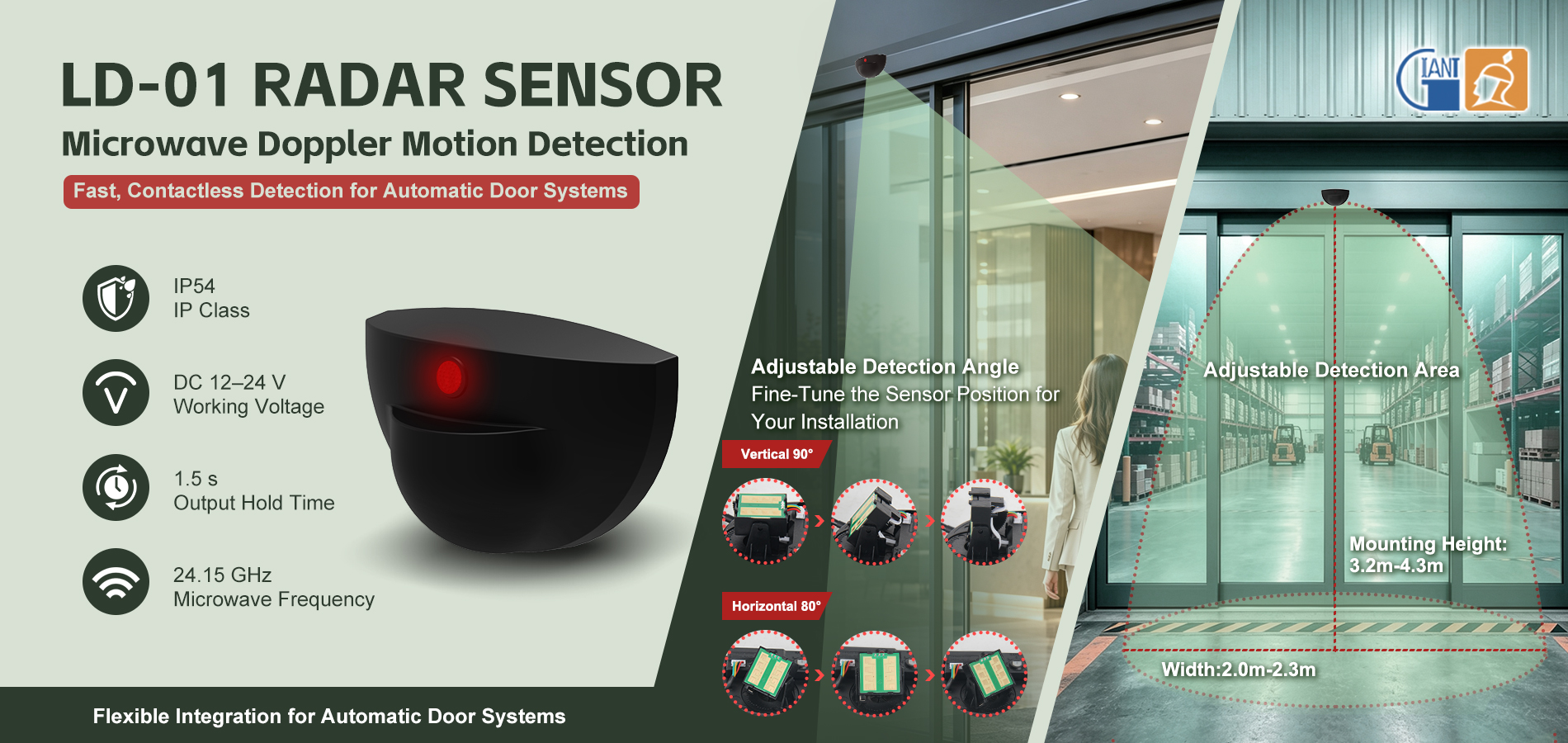
The JUJIANG GIANT LD-01 is a microwave Doppler radar sensor designed for motion detection in door-control applications. It provides fast response when a person approaches the monitored area and can be connected to a door controller through its clearly marked power and signal terminals.
The detection angle and sensitivity can be adjusted during installation, helping installers adapt the sensing area to different site conditions. Its compact design also supports flexible mounting on a door header or wall.
For B2B distributors and installers, the LD-01 focuses on practical integration, straightforward commissioning and stable motion detection for automatic door applications.
 37 Sunshine Road, Photoelectric Information Industrial Park, Nan'an, Fujian, China
© Copyright: 2022 Giant Alarm System Co.,Ltd All Rights Reserved.

IPv6 network supported


