
 English
 简体中文
简体中文  繁体中文
繁体中文 


Is a Longer Window Opener Stroke Always Better?
Is a Longer Window Opener Stroke Always Better?
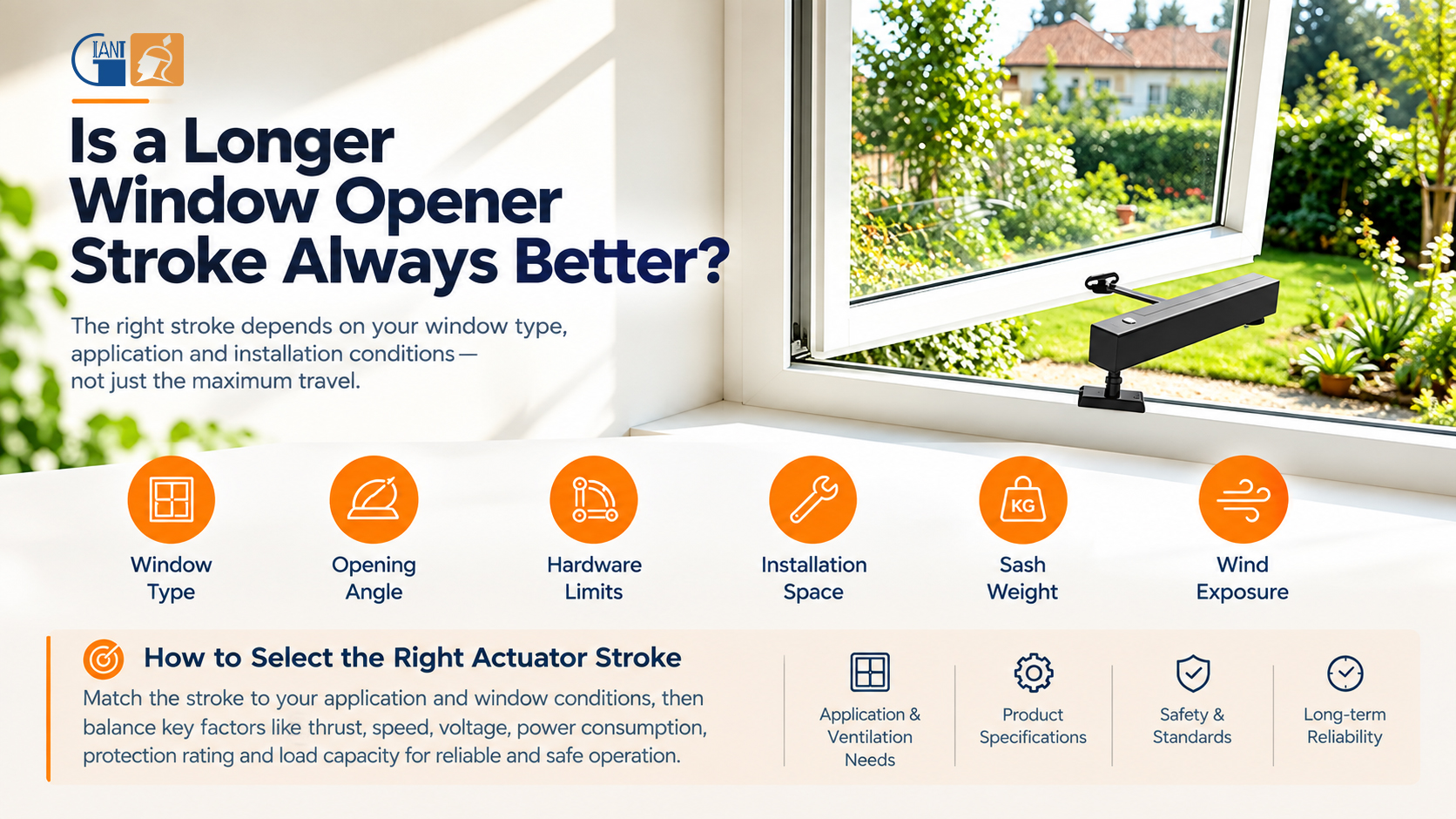
When specifying an electric window opener, it is easy to focus on the maximum stroke. A longer stroke may appear to provide a larger opening and better ventilation, but stroke length should never be selected by size alone. The right window actuator must match the window type, required opening angle, sash geometry, hardware limits, installation space, sash weight, and wind exposure. The key principle is simple: actuator stroke should follow the application rather than the maximum available travel.
1. Why More Stroke Is Not Always Better
A larger stroke does not automatically produce a proportionally larger effective opening. Once the sash reaches its required position, additional travel may provide limited practical benefit.
Window hardware also sets a physical limit. If an automatic window opener continues pushing after the sash or hinges reach their mechanical limit, excessive force can deform fittings, stress the frame or glazing, and overload the motor. For outward-opening windows, wind exposure should also be considered because a larger opening can increase the load on the sash and hardware.
Installation geometry is another important factor. A longer linear window actuator requires sufficient clearance when retracted and may not fit within the available frame or mounting area. It can also increase system cost, power consumption, and mechanical wear.
2. How to Select the Right Actuator Stroke
A better selection process starts with the application and required opening position, then determines the appropriate actuator stroke based on the product specifications. Key parameters include stroke, thrust, operating speed, input voltage, power consumption, protection rating, and window load capacity. These specifications should be checked against the requirements of the selected window and installation conditions to ensure reliable operation without excessive travel or load.
For natural ventilation, the window opener should provide the opening required for the intended airflow and comfort strategy. For smoke ventilation or other life-safety applications, requirements vary by market and project. Instead of assuming a universal opening angle, the required free or aerodynamic opening area, tested window configuration, actuator performance, and applicable local standards should be verified for the complete system. Professional actuator selection tools similarly consider window dimensions, weight, mounting conditions, stroke, opening angle, and free area.
3. JUJIANG GIANT Window Actuators: Controlled Travel for Different Applications
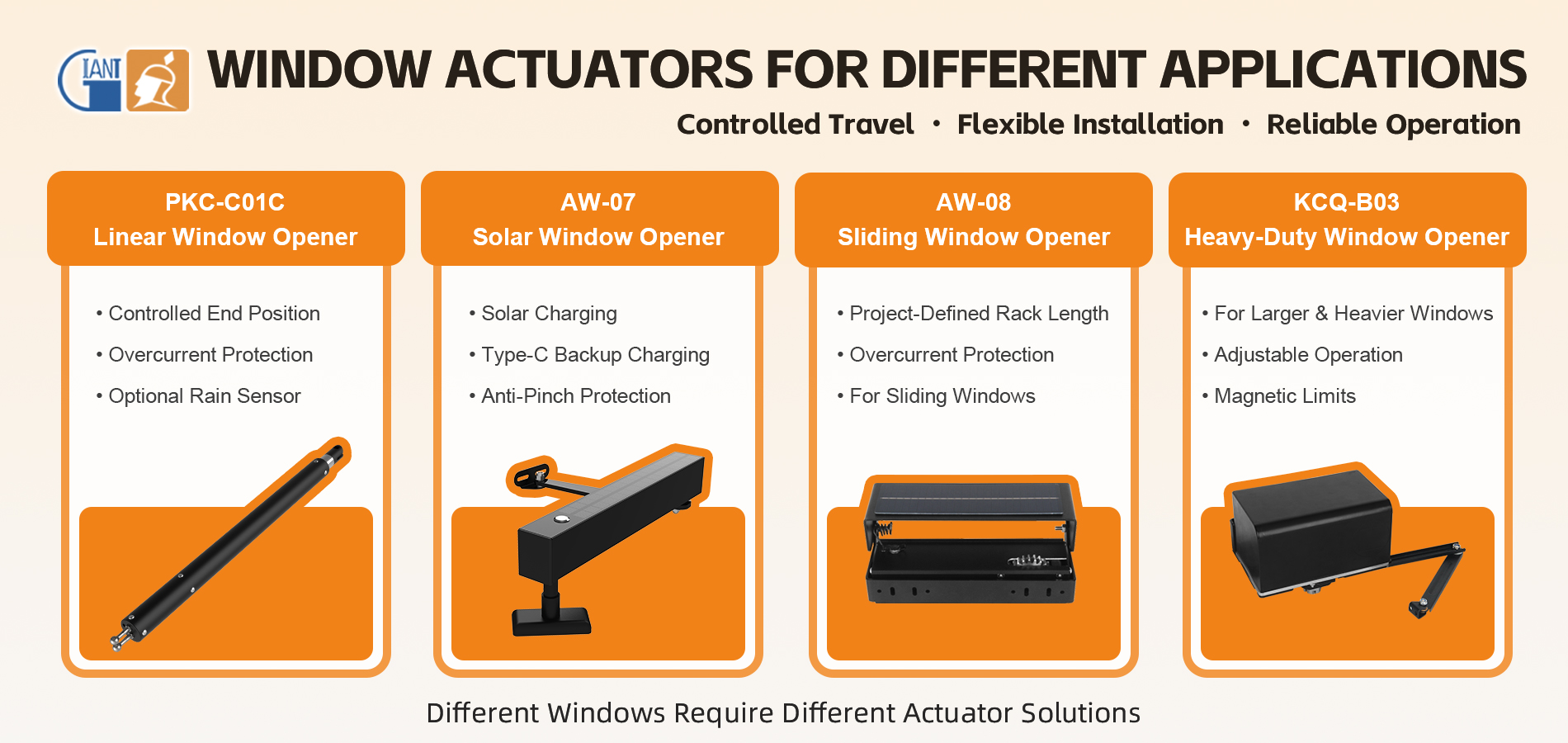
JUJIANG GIANT focuses on controlled opening rather than simply offering maximum stroke. According to the supplied product information, PKC-C01C linear window openeruses overcurrent detection for electronic end-position control and obstruction protection, with optional rain sensor integration. KCQ-B03 Heavy-Duty Window Opener s designed for larger or heavier windows and supports adjustable operating parameters and magnetic limits.
AW-08 is a sliding window opener with project-defined rack length, allowing the travel to be adapted to the window width. AW-07 Solar Window Opener combines solar charging or Type-C backup charging with magnetic limits, automatic travel learning, closing resistance adjustment, and anti-pinch protection.
The key value of an automatic window opener is not maximum travel. It is predictable, controlled movement that reaches the required position and stops reliably. For B2B distributors, installers, and project contractors, selecting the right window actuator system means balancing ventilation performance, hardware protection, installation constraints, safety, and long-term reliability.
 37 Sunshine Road, Photoelectric Information Industrial Park, Nan'an, Fujian, China
© Copyright: 2022 Giant Alarm System Co.,Ltd All Rights Reserved.

IPv6 network supported


