
 English
 简体中文
 繁体中文


How to Prevent Motor Overload in Electric Window Openers?
How to Prevent Motor Overload in Electric Window Openers?
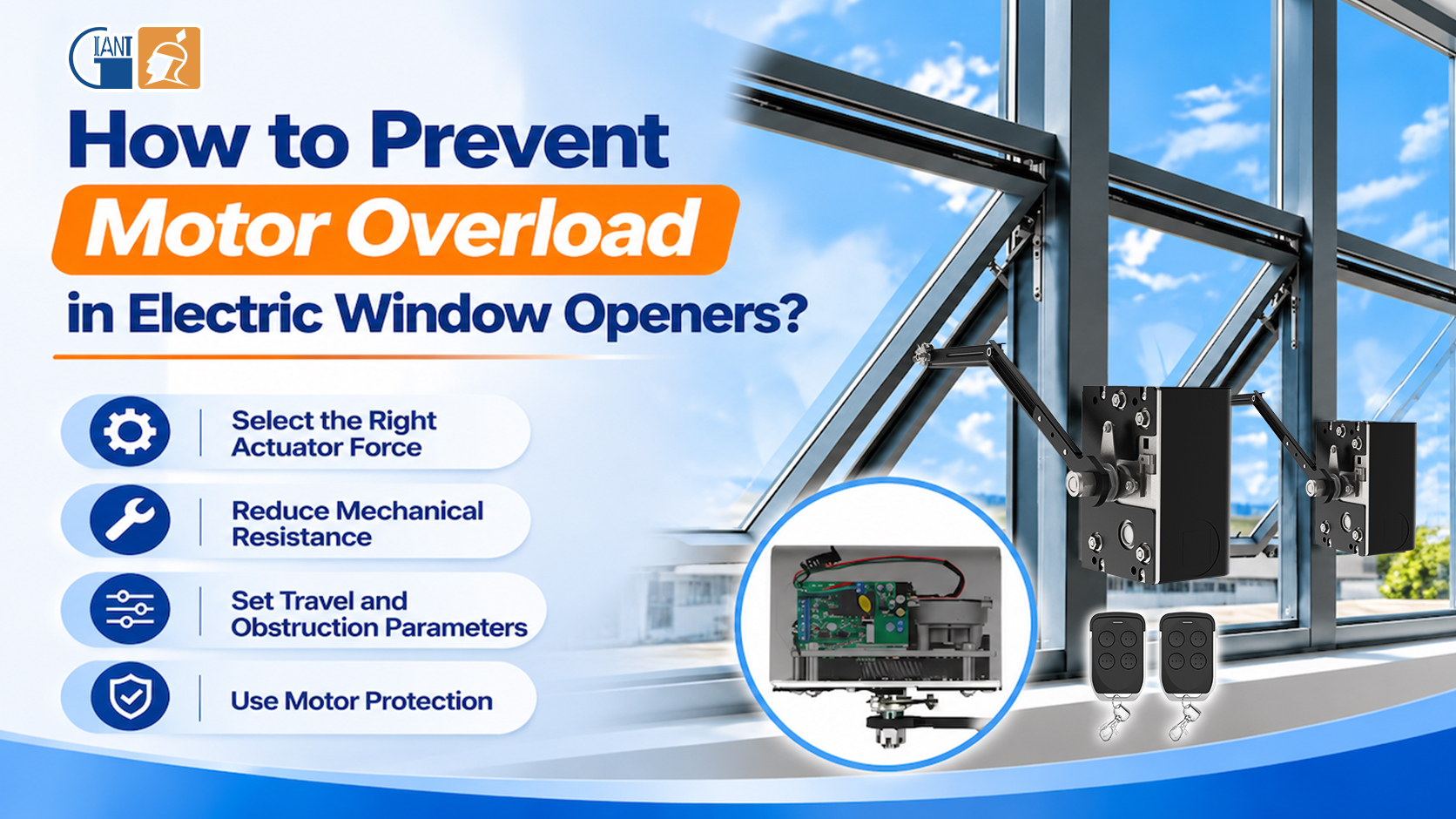
Electric window openers provide ventilation in many buildings. However, incorrect actuator sizing, wind pressure, operation and mechanical resistance can place excessive demands on the motor. Prolonged overload may cause overheating, accelerate insulation wear, damage drive components.
Preventing overload starts with correct selection and continues through installation, commissioning and maintenance.
1. How to Reduce the Risk of Motor Overload
Select the Right Actuator Force
Choose an electric window opener according to sash weight and dimensions, opening type, hinge arrangement and required opening angle. Consider local wind exposure: pressure on exposed facades can increase the force needed to move a window. Allow an operating margin instead of running continuously near the actuator’s rated limit.
Reduce Mechanical Resistance
A misaligned sash or obstructed drive can cause the motor to work harder than intended. Check that frames are square, hinges are aligned and tracks move freely. During maintenance, remove dust and debris, inspect hinges, seals and fittings, and lubricate moving parts as recommended.
Set Travel and Obstruction Parameters
Incorrect travel limits may cause the motor to keep pushing after the window is fully open or closed. Set opening and closing positions according to the product instructions. Where available, adjust obstruction detection or closing-force sensitivity, then test the settings after installation.
Use Motor Protection
Depending on the model, an automatic window opener may use current sensing, overload detection, run-time limits or thermal protection to respond to abnormal operation. These features can reduce the risk of damage from prolonged stalling, but cannot replace correct sizing and installation.
2. JUJIANG GIANT Window Opener Solutions
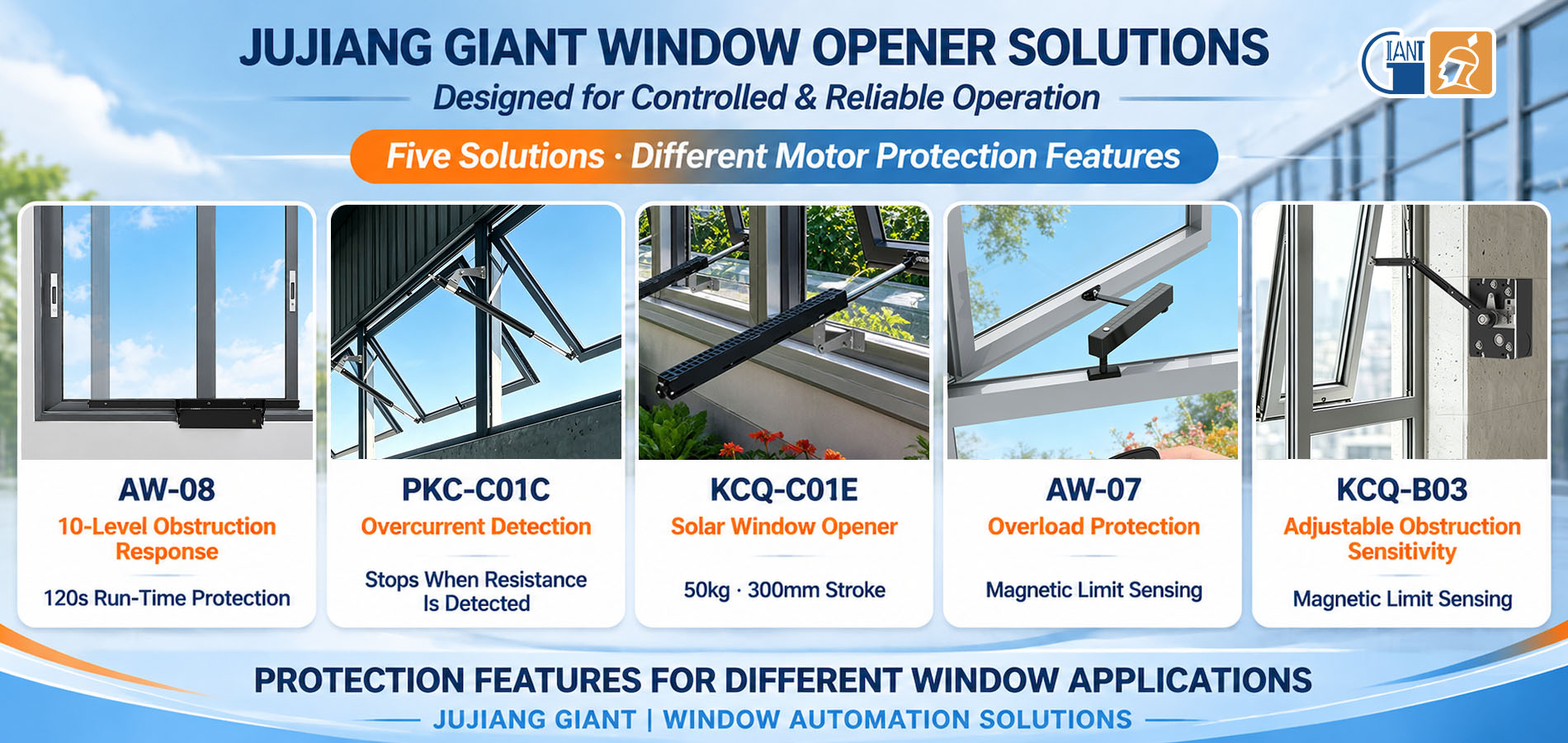
JUJIANG GIANT offers varied operating features across its motorized window opener range. Choose by window structure and power supply.
1. AW-08 Sliding Window Opener
This sliding window opener for automated ventilation is available in solar and adapter-powered versions. Adjustable obstruction response has 10 resistance levels, while 120-second run-time protection helps prevent prolonged operation. Its friction-based mechanism supports controlled operation.
2. PKC-C01C Linear Window Opener
This linear actuator window opener for outward-opening windows uses current detection to identify resistance and stop movement. Soft start, variable speed and soft stop reduce starting impact; high-speed duration has six settings.
3. KCQ-C01E Window Opener
This IP65 window actuator for exposed installations supports 100–230V AC input, a three-cell 3.7V lithium battery with solar charging. It handles loads up to 50kg with a 300mm stroke .
4. AW-07 Solar Window Opener
This solar-powered window automation system uses magnetic limit sensing to control travel. It supports solar or Type-C charging, automatic travel learning, a 20-second run-time cut-off and 10 closing-resistance settings.
5. KCQ-B03 Heavy-Duty Window Opener
This high-force window actuator for large sashes delivers up to 3,500N and supports window weights up to 200kg. A limit switch stops movement at the end of travel, while adjustable obstruction sensitivity and speed allow operation tuning. It supports 110V/220V AC input.
Conclusion
Reliable overload prevention combines suitable actuator sizing, smooth mechanical operation, accurate travel settings and protection features. Proper commissioning and maintenance help JUJIANG GIANT window openers deliver dependable ventilation.
 37 Sunshine Road, Photoelectric Information Industrial Park, Nan'an, Fujian, China
© Copyright: 2022 Giant Alarm System Co.,Ltd All Rights Reserved.

IPv6 network supported


