
 English
 简体中文
简体中文  繁体中文
繁体中文 


How to Choose an Automatic Window Opener: Key Parameters & Buying Guide
How to Choose an Automatic Window Opener: Key Parameters & Buying Guide
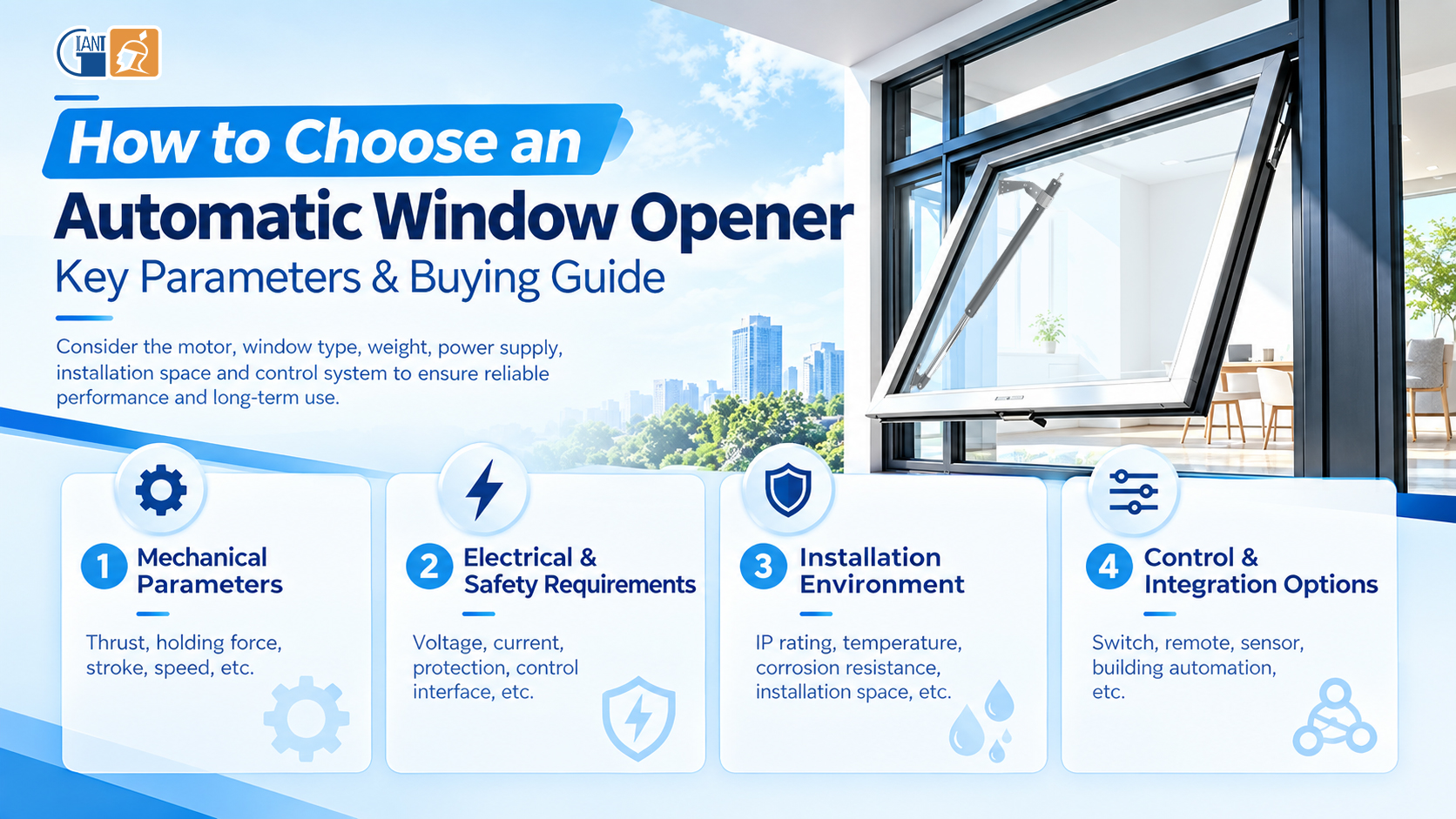
Choosing an automatic window opener is more than selecting a motor with the right price. The actuator must match the window type, sash weight, opening distance, power supply, installation space and control system. For commercial, industrial and high-level ventilation projects, these factors directly affect operating reliability, maintenance and long-term performance.
1. Check the Key Mechanical Parameters
Start with thrust, holding force, stroke and speed. The required force depends on the window's weight, wind load, friction and installation geometry. A suitable safety margin should be included rather than selecting an actuator based only on the window's static weight.
Stroke determines how far the window can open, while speed affects ventilation efficiency and project requirements. For smoke ventilation or fire-related applications, the required opening position and response time should be confirmed against the applicable local building and fire regulations rather than assuming one universal standard.
2. Match the Electrical and Safety Requirements
Check the available voltage, rated current, overload protection and limit control. Low-voltage systems can be useful where safety and centralized control are priorities, while mains-powered solutions may suit permanent installations.
Features such as obstruction protection, overload protection, soft start and soft stop can help reduce mechanical stress and improve operational safety. For building automation or fire-control projects, also verify whether the actuator supports the required dry-contact, RS485 or other control interface.
3. Consider the Installation Environment
For skylights, humid areas and outdoor-facing applications, the appropriate IP rating is important. Temperature range, corrosion resistance and material quality should also be considered, particularly in coastal or industrial environments.
Installation dimensions matter just as much. Confirm the actuator length, mounting points, brackets and available clearance before ordering. Different window configurations may require dedicated mounting accessories.
4. Evaluate Control and Integration Options
Depending on the project, an automatic window opening system may be operated by a wall switch, remote control, rain sensor or building automation system. For ventilation projects, rain-sensing automatic closure can provide an additional layer of convenience and weather protection.
For fire and smoke ventilation, always verify that the complete system—including the actuator, control panel and power backup—meets the requirements of the local authority and project specification.
5. JUJIANG GIANT Window Opener Solutions
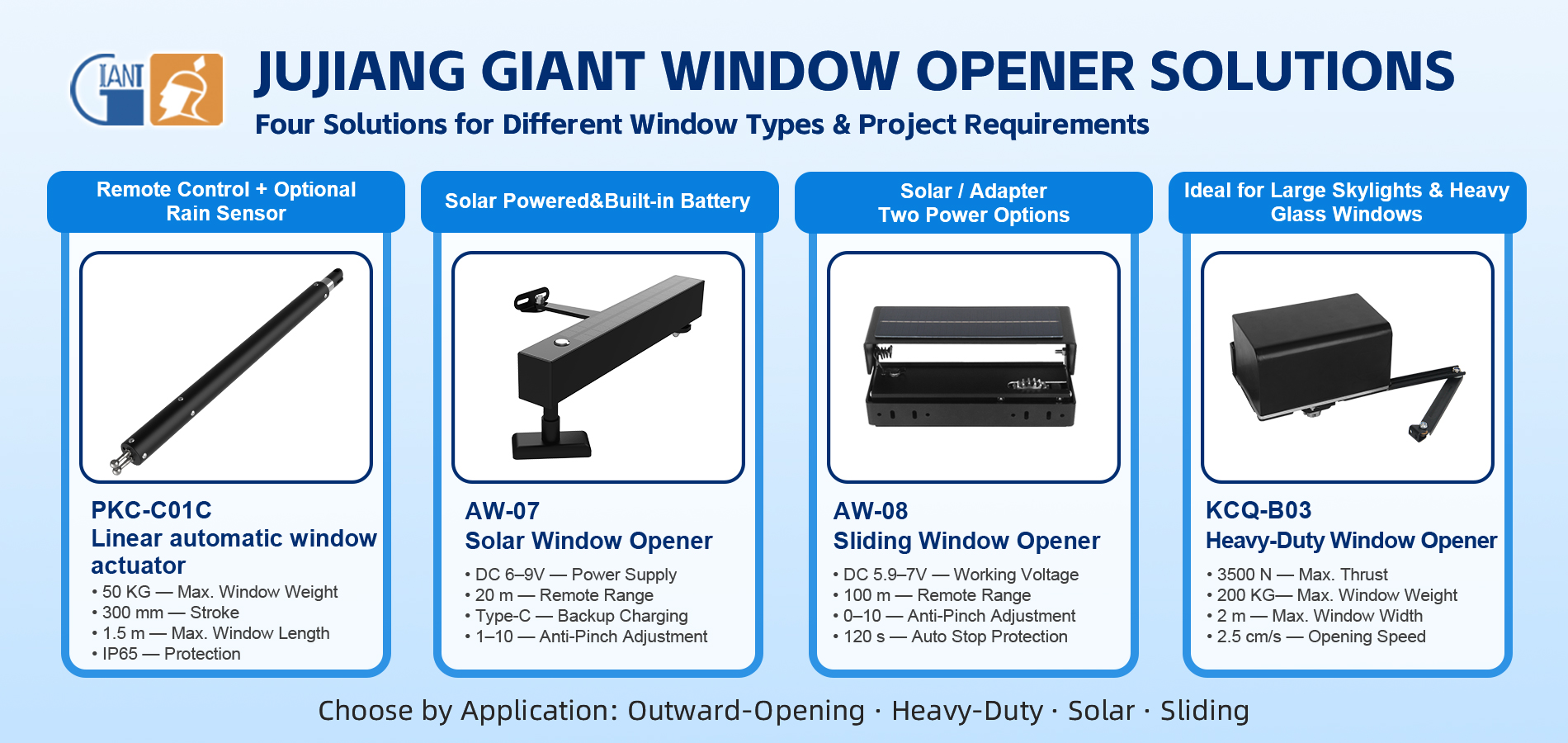
JUJIANG GIANT offers several electric window opener solutions for different applications. The PKC-C01C linear automatic window actuator supports AC110V/220V input, DC12V 10W output, 300mm stroke and a maximum window weight of 50kg. With overload protection, soft start/stop, remote control and an optional rain sensor, it is suitable for outward-opening windows and automated ventilation.
For larger windows, the KCQ-B03 heavy-duty electric window opener provides up to 3500N of thrust and supports windows up to 200kg and 2m wide. It is designed for large skylights, industrial ventilation and heavy glass windows.
For projects where wiring is difficult, the AW-07 solar window opener uses an integrated battery with solar charging and Type-C backup charging. The AW-08 sliding window opener is available in solar and adapter versions, making it suitable for sliding windows and low-wiring installations.
The right window opener motor should be selected according to the complete application—not one specification alone. Window type, dimensions, weight, opening requirements, power supply, environment and control method should all be evaluated before purchase.
 37 Sunshine Road, Photoelectric Information Industrial Park, Nan'an, Fujian, China
© Copyright: 2022 Giant Alarm System Co.,Ltd All Rights Reserved.

IPv6 network supported


